
Equity investors became poorer by over Rs 6.71 lakh crore on Thursday as domestic benchmark indices tumbled amid a global market meltdown. The 30-share BSE benchmark Sensex tanked 1,416.30 points or 2.61 per cent to settle at 52,792.23, tracking weak global markets and persistent foreign fund outflows. In line with the weak market trend, the market capitalisation of BSE-listed firms tumbled by Rs 6,71,051.73 crore to stand at Rs 2,49,06,394.08 crore.
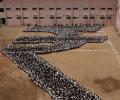
Reflecting nervousness over the prospect of the Federal Reserve tightening policy and event risk, traders stayed on the sidelines

Images from Day 2 of the Wimbledon tennis championships in London, on Tuesday.
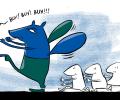
Smaller stocks have emerged as Dalal Street's favourites in 2023 that has turned out to be a "great year" for equities, rewarding investors with big gains, driven by optimism over the country's macroeconomic fundamentals and heavy retail investors participation. Experts said equity markets are experiencing a prolonged bull run and it is during this time that the midcap and smallcap segments tend to outshine their larger counterparts. Till December 22 this year, the BSE smallcap gauge has jumped 13,074.96 points or 45.20 per cent while the midcap index has surged 10,568.18 points or 41.74 per cent.

'Das is friendly, but he finally does what he does. The quality of engagement is very good.'

'Then select those that are well-aligned with your risk-return profile and investment time horizon.'

For the first time, the rupee declined to the low level of 80 against the US dollar in intra-day spot trading on Monday before ending the session 16 paise lower at 79.98 amid a surge in crude oil prices and unrelenting foreign fund outflows. At the interbank forex market, the local unit opened at 79.76 against the greenback but lost ground to touch the psychological low mark of 80 against the American currency. The local unit clawed back some lost ground and closed at 79.98, registering a fall of 16 paise over its previous close.

The impact of the Iraqi war on the US economy cannot be gauged until enough critical data relating to the period since the war's onset is available over the next several weeks, Federal Reserve policymakers said on Monday.

The S&P BSE Sensex gained 57 points to end at 26,064.

Shehbaz Sharif, the younger brother of former premier Nawaz Sharif, is expected to become Pakistan's new prime minister as the coalition of leading political parties led by them is set to comfortably cross the simple majority mark to form the next government after elections produced a split mandate.

IPO market hopes to come out of slump in festive season, reports Sundar Sethuraman.

Bharti Airtel was the top gainer in the Sensex pack, rallying over 4 per cent, followed by Axis Bank, Tata Steel, Titan, Maruti and Bajaj Finance. NSE Nifty surged 225.85 points to its record closing of 16,931.05.

'Gold prices thrive on volatility and more so when the stock markets trend downward.'

Referring to the ED's claim about the politician eating mangoes, sweets, aalo-poori etc regularly, he said these were provided to him only a few times.
Emerging markets like India and China are witnessing a remarkable transformation, despite a slowdown in economic growth, lifting millions of people out of poverty, Federal Reserve Chairman Ben Bernanke has said.
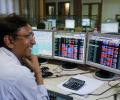
The 50-share NSE Nifty too rose by 20.35 points, or 0.19 per cent, to end at 10,908.70.

Nine of the top-10 most valued companies together lost a whopping Rs 309,178.44 crore in market valuation last week as selloffs continued. In a holiday-shortened past week, the 30-share BSE Sensex plummeted 1,836.95 points or 3.11 per cent amid geopolitical tensions, global sell-off triggered by a hawkish US Federal Reserve and unabated foreign fund outflows. From the top-10 list, State Bank of India was the lone gainer as its valuation jumped Rs 18,340.07 crore to reach Rs 467,069.54 crore.

Only the top 5 per cent profit makers account for 75 per cent of profits.

The market capitalisation of BSE-listed companies reached an all-time high of Rs 261.73 lakh crore on Thursday, helped by a massive rally in the equities where the benchmark Sensex zoomed 958 points to end at a fresh lifetime peak. The 30-share BSE benchmark jumped 958.03 points or 1.63 per cent to settle at its new closing peak of 59,885.36. During the day, it gained 1,029.92 points to touch an intra-day record high of 59,957.25.

Indian markets on Thursday shrugged off any negative impact.

A United States federal appeals court in New York has reserved the decision in connection with the 1984 anti-Sikh riots case against Congress President Sonia Gandhi.

Benchmark stock indices opened the week on a muted note on Monday, with the Sensex plunging nearly 483 points due to selling in IT, capital goods and banking shares amid losses in global equities. The Sensex tanked 482.61 points or 0.81 per cent to settle at 58,964.57. During the day, it tumbled 552.78 points or 0.92 per cent to 58,894.40. The 50-issue Nifty declined by 109.40 points or 0.62 per cent to finish at 17,674.95 as 29 of its stocks declined.
A Pakistani court reserved its decision on Monday, on a petition filed by authorities to challenge an anti-terrorism court's order rejecting a plea to declare Ajmal Kasab and Fahim Ansari as fugitives. A Rawalpindi-based bench of the Lahore High Court comprising Justices Rauf Ahmed Sheikh and Hasan Raza Pasha reserved its decision after hearing arguments by the counsel for the Federal Investigation Agency, which had filed the petition on April 10.
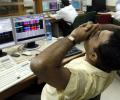
Tech Mahindra, the top loser in the Sensex pack, shed over 2.5 per cent. It was followed by UltraTech Cement, Reliance Industries, HCL Tech, HDFC, Kotak Bank, HDFC Bank and TCS. NSE Nifty plunged 179.35 points to 17,745.90.

Bajaj Finserv was the top gainer in the Sensex pack, rising over 4 per cent, followed by L&T, HDFC, Axis Bank, SBI, Reliance Industries and IndusInd Bank. NSE Nifty soared 276.30 points to its new closing peak of 17,823.

The central government is on track to meet its fiscal deficit target of 6.4 per cent of the GDP for 2022-23 on the back of strong growth in revenue collections, the World Bank said in its India Development Update on Tuesday. High nominal GDP growth in the first quarter supported strong growth in revenue collection, especially Goods and Services Tax (GST), despite tax cuts on fuel. Notwithstanding an increase in spending due to expanded fertilizer subsidies and food subsidies for vulnerable households in response to the commodity price shock, the government is on track to meet its FY22/23 fiscal deficit target of 6.4 per cent of GDP and the general government deficit is projected to decline to 9.6 per cent from 10.3 per cent in FY21/22 and 13.3 per cent in FY20/21.

Top gainers in the Sensex pack included Infosys, Bajaj Finance, Maruti, HUL, HCL Tech and Reliance Industries, while M&M, IndusInd Bank, ITC, PowerGrid and L&T were among the losers. The NSE Nifty settled 190.80 points, or 2.51 per cent, down at 7,801.05.

Benchmark indices failed to hold on to early gains and closed in the red for the seventh straight session on Thursday, with participants remaining in wait-and-watch mode ahead of the RBI's interest rate decision. Unabated selling by foreign funds added to the pressure, though a modest recovery in the rupee cushioned the fall, traders said. After rallying in early trade, the 30-share BSE Sensex came under selling pressure in the afternoon session and closed 188.32 points or 0.33 per cent lower at 56,409.96.
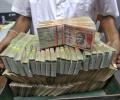
The rupee ended lower by six paise at 65.73 against the US dollar on Monday.

'I found it unbelievable that L&T said 45,000 jobs were waiting to be filled because of unavailability of suitable skillsets.' 'So, when the Opposition sweepingly says there are no jobs, I'm sorry... I'm not saying it's raining jobs, but there are jobs. The (skill) gap has to be bridged.'

'We are in a sweet spot.' 'Equity, on a standalone basis, will continue to remain the asset class to stay invested in.'

The hacking took place on the night of February 4.

Bajaj Finance was the top gainer in the Sensex pack, soaring around 8 per cent, followed by IndusInd Bank, Bajaj Finserv, ICICI Bank, Kotak Bank, SBI, Bajaj Auto and HDFC Bank. NSE Nifty surged 211.50 points to 14,864.55.

Domestic equities will be mainly driven by global market trends, foreign institutional investors' movement and developments around new Covid variant Omicron this week, according to analysts. Markets traded under pressure last week following weak global cues and overall investor sentiment remained downbeat throughout the week, they observed. "Global markets, Omicron variant, dollar index and FIIs' behaviour will be key factors to drive the market this week," said Santosh Meena, head of research, Swastika Investmart Ltd. One major event last week was US Federal Reserve's announcement that it will end bond-buying from March, and it also signalled starting rate hike cycle thereafter.

A bomb disposal squad will sanitise the Islamabad Sports Complex every morning, and two escort vehicles will shadow the Indian Davis Cup team during its travel as part of multi-layer security arrangement, which is usually accorded to the Head of State, to ensure the visiting tennis players' safety and security.

A total of 161.30 acres of land, plant, machinery and building of the Kannad Sahakari Sakhar Karkhana Limited (Kannad SSK) located in Kannad village of Aurangabad district has been provisionally attached under the Prevention of Money Laundering Act (PMLA), the ED said in a statement.
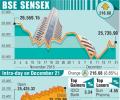
The S&P BSE Sensex surged 217 points to end at 25,736.

There are already some signs of stress in this market.
Expressing reservations on some clauses in the two bills introduced in the Lok Sabha relating to a federal agency and Unlawful Activities (Prevention) Amendment, the Communist Party of India-Marxist on Wednesday demanded the proposed legislations be referred to the Standing Committee of Parliament.
